Google_plus Pinterest Vimeo RSS
Showing posts with label Terrorism. Show all posts

’القاعدہ کے انکار پر لشکرِجھنگوی کا طالبان سےگٹھ جوڑ‘

’القاعدہ کے انکار پر لشکرِجھنگوی کا طالبان سےگٹھ جوڑ‘

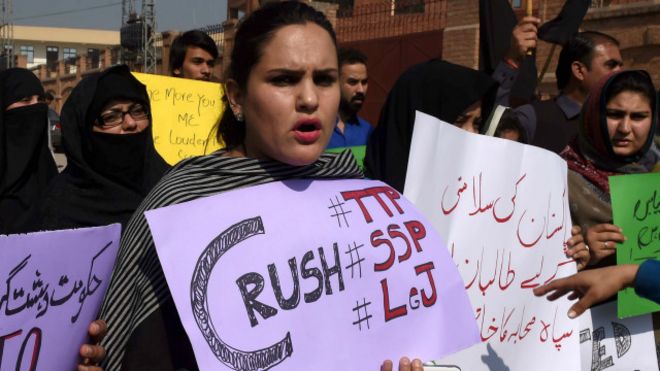
لشکرِ جھنگوی سمیت شدت پسند تنظیموں کے خلاف کارروائی کے لیے حالیہ دنوں میں مظاہرے بھی ہوئے ہیں
حکومت پاکستان نے کہا ہے کہ ملک میں فرقہ وارانہ تشدد کے حالیہ واقعات میں کالعدم تنظیم لشکر جھنگوی ملوث ہے جس کا مقصد تنظیم کے ارکان کی پھانسیاں رکوانے کے لیے حکومت پر دباؤ ڈالنا ہے۔
وفاقی وزارتِ داخلہ کی طرف سے صوبوں کو لکھے گئے ایک خط میں کہا گیا ہے کہ اس کالعدم تنظیم نے کارروائیوں کے لیے القاعدہ سے بھی مدد مانگی تھی اور وہاں سے انکار پر اس نے تحریکِ طالبان پاکستان کے ساتھ گٹھ جوڑ کر لیا ہے۔
خط میں کہا گیا ہے کہ اطلاعات کے مطابق لشکرِ جھنگوی نے جیلوں میں قید اپنے شدت پسندوں کی رہائی کے لیے عام لوگوں کو یرغمال بھی بنا سکتی ہے۔
وزارتِ داخلہ کا کہنا ہے کہ جنوبی پنجاب کے علاقے کبیر والا کے ایک شخص عبدالرحمان کو پنجاب میں لشکر جھنگوی کی کارروائیوں کی نگرانی کی ذمہ داری سونپی گئی ہے اور اس نے لاہور سمیت مختلف علاقوں بڑے حملوں کی منصوبہ بندی کی ہوئی ہے۔
خط میں اس بات کا بھی ذکر کیا گیا ہے کہ سکیورٹی فورسز اور قانون نافذ کرنے والے اداروں کی طرف سے اس تنظیم کے کارکنوں کے خلاف کریک ڈاؤن کے بعد اس کے ارکان نے القاعدہ سے مدد مانگی تھی تاہم القاعدہ کے ذمہ داران نے عراق اور شام میں مصروفیت کی وجہ سے لشکرِ جھنگوی کی مدد کرنے سے معذوری ظاہر کر دی تھی۔
وزارتِ داخلہ کا کہنا ہے کہ القاعدہ کے انکار کے بعد تنظیم نے کالعدم تحریک طالبان پاکستان کے امیر ملا فضل اللہ سے رابطہ کیا جنھوں نے نہ صرف لشکر جھنگوی کو مالی معاونت فراہم کی بلکہ اُنھیں مزید معاونت فراہم کرنے کا بھی وعدہ کیا ہے۔
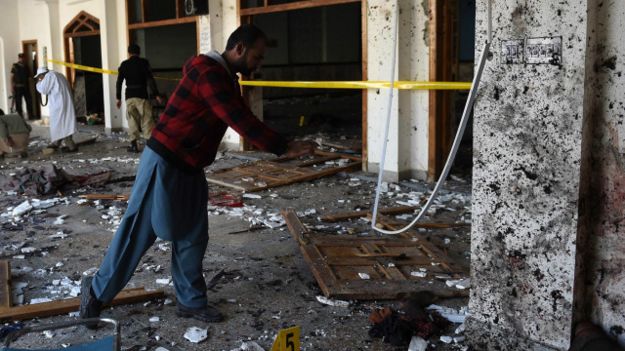
رواں برس شیعہ مسلک کی مساجد پر کم از کم تین بڑے حملے ہو چکے ہیں
سرکاری دستاویز میں یہ بھی کہا گیا ہے کہ ملک میں اہل تشیع کو نشانہ بنائے جانے کا مقصد حکومت پر دباؤ ڈالنا ہے کہ وہ مذکورہ تنظیم سے تعلق رکھنے والے افراد کی پھانسیوں پر عمل درآمد روک دے۔
حکومت نے خفیہ اداروں کی رپورٹ کی روشنی میں تمام صوبوں کے اعلیٰ حکام کو سرکاری عمارتوں، امام بارگاہوں اور عبادت گاہوں کے اردگرد حفاظتی اقدامات کو بہتر بنانے کی ہدایت کی ہے۔
حکومت کے مطابق ملک میں حالیہ شدت پسندی کے واقعات کے پیچھے لشکر جھنگوی اور ملا فضل اللہ کا گٹھ جوڑ ہے۔
خیال رہے کہ پشاور میں شیعہ مسجد پر حملے کی ذمہ داری بھی تحریکِ طالبان کی جانب سے ہی قبول کی گئی تھی اور تنظیم نے حملہ آوروں کی ویڈیو بھی جاری کی تھی۔
پشاور میں ہی گذشتہ برس دسمبر میں آرمی پبلک سکول پر ہونے والے طالبان کے حملوں کے بعد ملک میں سزائے موت پر عمل درآمد کا سلسلہ شروع ہوا تھا۔
اس سلسلے میں اب تک 22 مجرموں کو پھانسی دی جا چکی ہے جن میں لشکرِ جھنگوی سے تعلق رکھنے والے متعدد شدت پسند بھی شامل ہیں۔
رواں ماہ کی تین تاریخ کو بھی کراچی میں لشکرِ جھنگوی کے دو ارکان کی پھانسی کے بعد دو نجی سکولوں کے قریب کریکر دھماکوں کے بعد پولیس کو جائے وقوع سے ایسے پمفلٹ بھی ملے تھے جن میں متنبہ کرتے ہوئے کہا گیا تھا کہ ’ہمارے لوگوں کو پھانسی دینے اور جعلی مقابلوں میں مارنے کا سلسلہ بند کرو ورنہ یہ واقعہ بھرے سکول میں بھی پیش آ سکتا ہے۔‘

Radical Madressah Networks in Punjab Lie at the Heart of Pakistan's Terrorism Problem...Z.H.(Dawn)

The writer is an author and journalist.
FINALLY we seem to have a national counter-terrorism plan and it is now time for the government to fight the battle against militancy. Notwithstanding the controversy over the decision to set up military courts and the resumption of executions, overall the plan does provide a coherent framework for action.
But the plan by itself may not suffice. Have we not had some tough anti-terrorism laws operating already? So the real question is how effective can the government be in its actions. What we have seen thus far is the prime minister doing more of the mundane: he has been busy setting up committees, more committees and sub-committees. There’s no sign of urgency.
The foremost challenge for Mr Sharif will be how he deals with the problem of militancy and religious extremism in his home province of Punjab. For long, counterterrorism efforts have been focused entirely on the tribal areas and Khyber Pakhtunkhawa and the state has conveniently shut its eyes to militant activities in the country’s most powerful province. This inaction cannot be dismissed as just a state of denial, and has more to do with expediency.

Radical madressah networks in Punjab lie at the heart of Pakistan’s terrorism problem.


Deliberately wrapped up in the jargon of ‘good militants’, they were considered a useful cog in our twisted national security paradigm. The fear of retaliation was also the reason for handling them with kid gloves. Will the new counterterrorism strategy really be a game-changer? One is not so sure.
Indeed, a crackdown on Punjab-based militants is a part of the 20-point action plan and both the civil and military leadership have pledged to end the dubious distinction between ‘good Taliban’ and ‘bad Taliban’. Yet, there is still no indication of this much-touted policy shift coming into play, at least in Punjab.
While the focus has remained on the TTP and some other militant groups engaged in fighting security forces in the northwest, it is actually Punjab that had turned into the main centre of militancy and religious extremism. Most of the banned militant and sectarian outfits have their base in the province. What the civilian and military authorities conveniently tend to ignore is that many of the terrorist attacks in the country were linked to Punjab-based groups.
In fact, the venues of some of the most horrific and audacious terror attacks have been in Lahore, Rawalpindi and Islamabad. Be it the attacks on the FIA building, a police training centre, Moon Market, the Data Darbar massacre in Lahore or the brutal carnage in Rawalpindi’s Parade Lane mosque and the attack on GHQ and the devastating bombing of Islamabad’s Marriot, all were carried out by a nexus of the TTP, Al Qaeda and Punjab-based militant groups.
A loose coalition of militants of Punjabi origin calling themselves Punjabi Taliban came into prominence after those attacks. A significant number of Punjabi Taliban were involved in fighting along with the TTP in Swat and the tribal areas. Since 2005, thousands of militants from southern and northern Punjab reportedly moved to Waziristan and worked in close alliance with the TTP in planning attacks on Punjab’s cities. Many of them had also established their training bases in North Waziristan.
The Punjabi Taliban are mostly drawn from the ranks of outlawed militant and Sunni sectarian outfits like Jaish-e-Mohammed, Harkatul Mujahideen and Lashkar-i-Jhangvi that have operated with impunity under new banners in the province and outside.
The Punjabi Taliban are relatively more educated, better trained and more ideologically motivated than their Pakhtun allies. Hence it is not surprising that they have been the masterminds behind some of the most high-profile terrorist attacks. Investigations into the 2008 Islamabad Marriott Hotel bombing have established a strong Punjab connection.
Despite the growing evidence of terrorist attacks involving these militants and other groups operating in the province, even the mention of Punjabi Taliban would evoke a fierce reaction by the Sharif government and security agencies. It did not stop at that. There have been some reports of the PML-N entering into deals with sectarian groups in the last elections.
It is an open secret that the prime minister stopped the execution of two LeJ militants convicted for sectarian killings after threats from Asmatullah Muawiya, the self-styled chief of the Punjabi Taliban. He was also believed to be the commander of one of several Al Qaeda military cells operating in Punjab. Interestingly, a few months later Muawiya announced the end of the group’s armed struggle against Pakistani security forces, limiting its activities to fighting US-led coalition forces in Afghanistan. Many believe the truce was the result of a deal.
Radical madressah networks in Punjab lie at the heart of Pakistan’s militancy problem. Most of the Punjabi Taliban leaders received their ideological training in those hardline seminaries, nurtured and expanded under state patronage in the 1980s. Many of these madressahs are also linked with LeJ, a group closely connected with Al Qaeda.
Rightly described as the epicentre of sectarian militancy, the province has also been the main venue of attacks on religious minority groups such as Ahmadis and Christians. The rise of religious extremism in the province is mainly linked to the growth of foreign-funded Salafi seminaries and the failure of the state to check their activities.
Then there is the question about organisations, which may not be engaged in fighting at home, but are deeply involved in terrorist activities in neighbouring countries. Will people like Hafiz Saeed and Maulana Masood Azhar still be allowed to operate freely under the new counterterrorism action plan? It is not clear yet whether our security agencies have finally cut the umbilical cord with their former clients. Acceptance of militant organisations under any pretext will defeat the entire counterterrorism effort.
It is Punjab where the real battle against violent extremism will have to be fought to reclaim the country’s original identity of a progressive Muslim state. Reluctance to tackle the militancy and sectarian problem in the province raises serious doubt about the country winning this battle.
The writer is an author and journalist.
Twitter: @hidhussain
Published in Dawn, December 31st, 2014
ہنگو: چہلم کی مجالس کو نشانہ بنانے کے منصوبے کا انکشاف

۔—فائل فوٹو۔
۔—فائل فوٹو۔
پشاور: خیبر پختونخواہ کےضلع ہنگو میں چہلم امام حسین کی مجالس کونشانہ بنانے کے بڑے منصوبےکا انکشاف ہوا ہے۔
سرکاری ذرائع کے مطابق ہنگو میں ذیاڑ ڈونگا کے پہاڑوں میں 20 سے 25 شدت پسندوں کا گروپ دیکھا گیا ہے جو بھاری ہتھیاروں اور بارودسےمکمل طور پرلیس ہیں۔
انہوں نے بتایا کہ یہ گروپ چہلم امام حسین کے جلوسوں کو نشانہ بناسکتا ہے۔
ذرائع کاکہنا ہے کہ اس حوالے سے محکمہ داخلہ کی جانب سےسخت ترین سیکیورٹی اقدامات کی ہدایات جاری کردی گئیں۔
ان کا مزید کہنا تھا کہ کور ہیڈ کوارٹر، فرنٹیئر کور اور خیبر پختونخوا پولیس کےسربراہان کو بھی الرٹ جاری کر دیاگیا ہے۔

Pakistan ranks third on Global Terrorism Index

Pakistan ranks third on Global Terrorism Index


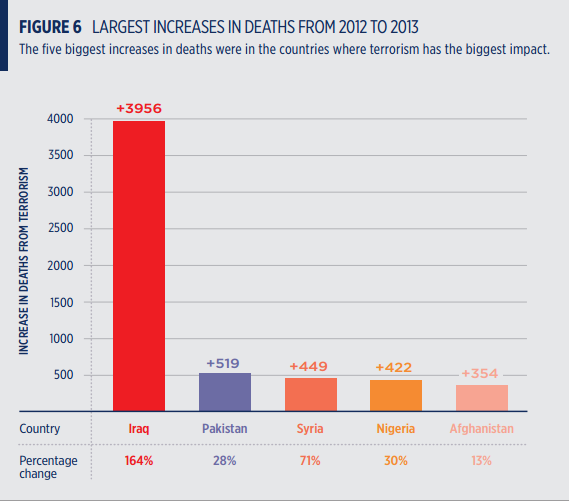
The report said Iraq was the country hit hardest by terrorism, with 2,492 attacks that killed more than 6,300 people. It was followed by Afghanistan and Pakistan, with Nigeria and Syria in fourth and fifth place respectively.
With 10,000 worldwide attacks in 2013, the report says Pakistan in particular saw a 37 per cent increase in deaths and 28 per cent increase in injuries since 2012. The report also said that deaths resulting from terror incidents in Pakistan, Iraq, Afghanistan, Nigeria and Syria account for more than 80 per cent of the the total deaths from attacks.
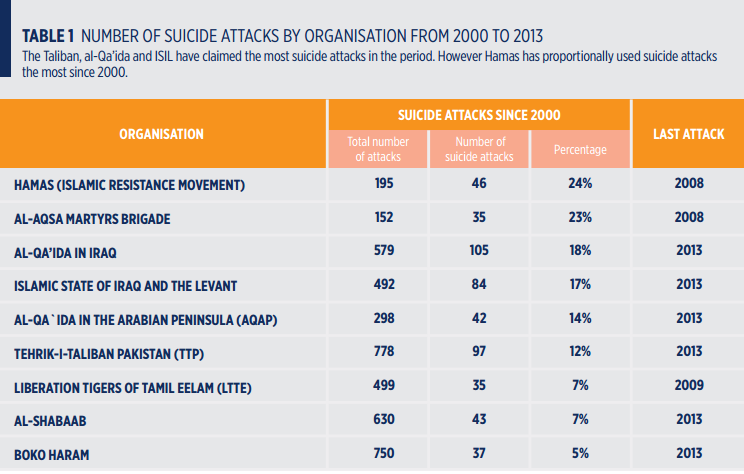
The report also says that the Tehreek-i-Taliban Pakistan (TTP) between 2000 and 2013 has claimed 778 attacks, of which 12 per cent were carried out by suicide bombers. It also says that the Taliban have the highest number of fighters, estimated to be between 36,000 to 60,000.
1: Pakistan is ranked third on the GTI list.
2: Over 80 per cent of the lives lost to terrorist activity in 2013 occurred in only five countries Iraq, Afghanistan, Pakistan, Nigeria and Syria.
3: Terrorism in Pakistan is strongly influenced by its proximity to Afghanistan with most attacks occurring near the border involving the Taliban. Like in Afghanistan, terrorism increased significantly in Pakistan in 2013, with a 37 per cent increase in deaths and 28 per cent increase in injuries since 2012. Nearly half of all attacks had no groups that have claimed responsibility.
4: The deadliest group in Pakistan in 2013, responsible for almost a quarter of all deaths and 49 per cent of all claimed attacks, is Tehrik-i-Taliban Pakistan (TTP), the Pakistani Taliban.
5: Terrorism in Pakistan has a diverse array of actors. In 2013 there were 23 different terrorist groups, down from 29 groups in 2012. However, 11 groups account for the majority of the 270 claimed attacks. While many of these groups are Islamist there are also other organisations such as separatist movements for Baloch, the Bettani tribe and Sindhi people.
6: Over 60 per cent of fatalities were from bombings and explosions and around 26 per cent from firearms.
7: A quarter of targets and deaths were against private citizens, with police accounting for 20 per cent of targets and deaths. The deadliest attacks were against religious figures and institutions which, on average, killed over five people and injured over 11 per attack.
8: In 2013 there were over 100 attacks on educational institutions, with a total of 150 casualties.
9: In 2013 there were 71 suicide attacks responsible for around 2,740 casualties.
10: More than 500 cities in Pakistan had at least one terrorist incident in 2013, with two or more incidents occurring in 180 cities. Of all attacks 16 per cent occurred in the largest city of Karachi in the south.
11: The city of Parachinar in the Federally Administered Tribal Areas, the closest point in Pakistan to Kabul in Afghanistan, has among the highest rates of deaths per incident in Pakistan with 87 people killed from seven incidents.
12: Generally, the dispute with Pakistan over Jammu and Kashmir is the source of terrorism. In 2013 three Islamist groups were responsible for around 15 per cent of deaths. This includes Hizbul Mujahideen, an Islamist group allegedly based in Pakistan with a membership of around 15,000.
13: The country with the second largest increase in the numbers of deaths was Pakistan. However, Pakistan saw a much smaller increase than Iraq with 520 more deaths in 2013 than 2012.
14: Pakistan saw a substantial increase in the number of deaths per attack. In particular, the second and third biggest terrorist groups, Lashkar-e-Jhangvi and Jundallah, averaged 20 more fatalities per attack in 2013 than the previous year. This highlights the growing lethality of the groups.